
Product
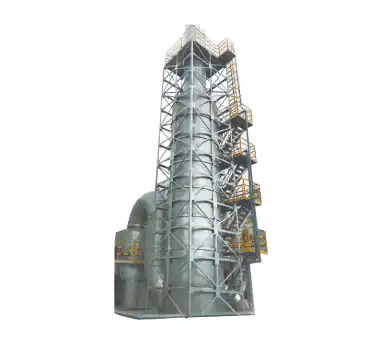
Flue Gas Desulfurization System
The high-temperature dust-laden flue gas at the boiler outlet first enters a horizontal Venturi section (the Venturi is arranged using part of the flue duct, which does not affect the overall layout size and is concentrated at the dust collector inlet). The gas is guided through a converging section into the throat, where the flue gas velocity suddenly accelerates to 40–45 m/s.
A specially designed atomizing nozzle installed at the upper part (manufactured using imported U.S. technology and made of nano polymer composite material) sprays atomized water to humidify the flue gas. Extremely fine dust particles in the gas (approximately 1–1.55 μm) become surrounded by numerous ultra-fine water droplets, increasing their weight. After high-speed collisions, the particles agglomerate and increase in size.
The gas then enters the diverging section, where the velocity rapidly decreases to 8–10 m/s, further accelerating particle agglomeration and size growth. The gas is then discharged from the diverging section at relatively high speed, rotating and rising along the tangential direction. About 70% of the dust particles are thrown onto the inner wall of the dust collector and are washed downward by the water film formed by the special overflow trough installed inside the collector, flowing to the ash-water outlet at the bottom.
The remaining approximately 30% of dust-laden flue gas rises in a swirling motion under the guidance of the reverse-flow tower core column and the upper swirl plates. It then enters the high-efficiency first and second-stage wet swirl plates. The desulfurization liquid forms a water film on the blades and swirl plates. Under the impact of high-velocity flue gas, fluidization occurs within the plates, and the gas continues rotating upward into the gas–liquid separation swirl plate, where steam and water are separated.
Afterward, the gas passes through a “labyrinth-type” steam separator formed by an inverted cone mushroom cap and a waterproof eave, which further separates moisture. The cleaned flue gas is then discharged through the flue duct, drawn by the induced draft fan, and released into the atmosphere through the chimney.
In traditional demister plate designs, solving only the demisting issue is far from sufficient. In the overall design of the desulfurization system, it is necessary to fully address moisture carryover and condensation phenomena to fundamentally solve the problem of water entrainment.
The ash-water produced after wet swirl plate desulfurization and dust removal, together with the ash-water flowing down along the outer edge of the tower core column through the liquid guide channels and the ash-water discharged from the Venturi high-efficiency pre-desulfurization dust collector, is discharged from the bottom ash outlet to the sedimentation tank for settling and separation. The wastewater is then recycled for continued circulation.
Performance Features
- High-quality main structural materials with excellent resistance to high temperature, wear, and corrosion, ensuring long service life.
- Stainless steel atomizing desulfurization nozzles, made of special stainless steel materials with strong desulfurization capability.
- High gas–liquid separation efficiency, resulting in low moisture concentration at the induced draft fan inlet.
- Tower core column liquid-guiding design with excellent flow-guiding performance, strong auxiliary purification capability, and no risk of blockage.
- Maintenance-free overflow trough design with strong water distribution capability and no blockage in the lower overflow section.
Need a Custom Dust Collector Solution?
Every industrial facility has different dust control requirements. Our engineers are ready to assist you in selecting and designing the most suitable dust collection system for your application